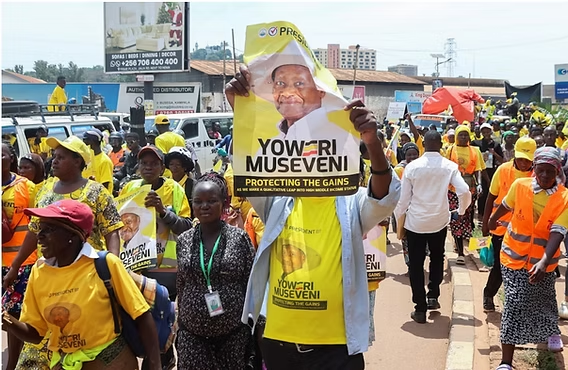
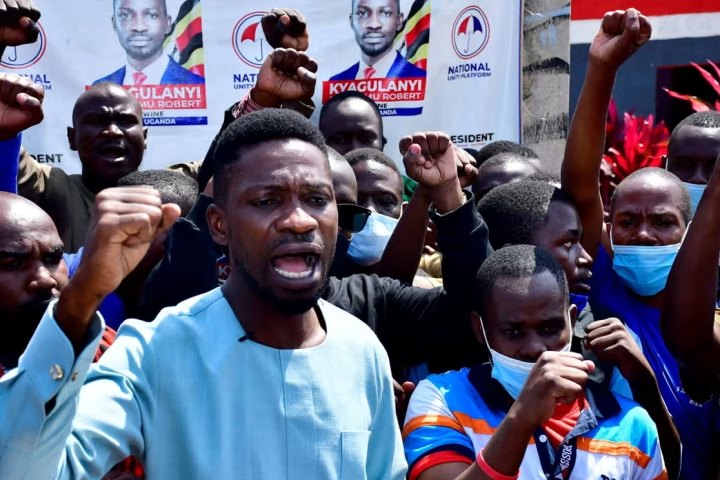
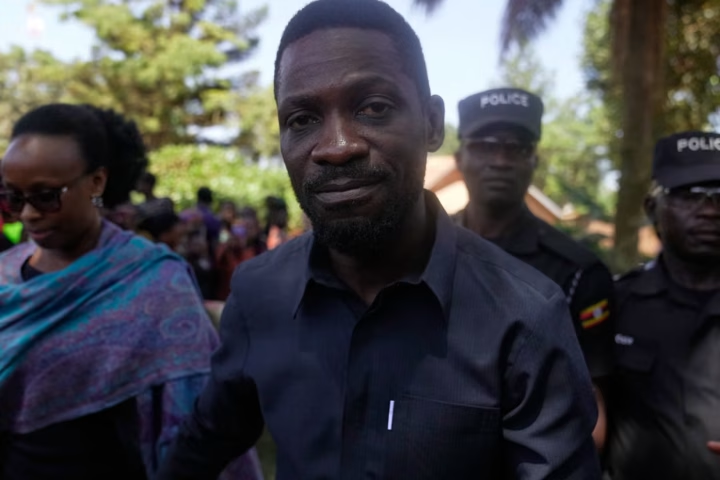
Uganda’s general elections, held on 15 January 2026, concluded with the Electoral Commission declaring Yoweri Museveni the winner of the presidential race. The announcement triggered an immediate and heavy security deployment in parts of Kampala, including the Magere neighborhood, where opposition leader Robert Kyagulanyi Ssentamu—popularly known as Bobi Wine—resides.
Electoral framework and conduct
Under Uganda’s two-round presidential system, a candidate must secure 50 percent plus one vote to win outright. Term limits, removed in 2005, allowed the incumbent to seek another term. The Electoral Commission of Uganda oversaw voting for the presidency and the 529-member Parliament, comprising constituency seats, women’s district seats, and special-interest group representatives elected via electoral colleges.
Election day was marked by delays of up to four hours in several constituencies, attributed to technical problems with biometric kits and shortages of materials. The Commission authorized the use of paper registers to prevent disenfranchisement and extended polling by one hour beyond the scheduled close.
Campaign climate and restrictions
The pre-election period saw intensified pressure on the opposition, particularly the National Unity Platform (NUP). Multiple arrests of party members were reported, and campaign events were disrupted by security forces. International observers and rights groups, including Amnesty International, described the environment as one of repression, citing crowd dispersals with tear gas and allegations of beatings.
On 13 January 2026, authorities ordered a mobile internet shutdown, citing concerns over misinformation and incitement. Opposition leaders argued the blackout impeded transparency and facilitated irregularities.
Results and immediate aftermath
The Electoral Commission chair announced that Museveni had obtained more than 50 percent of valid votes, declaring him elected president. Official tallies placed Museveni ahead of Kyagulanyi by a wide margin. The ruling National Resistance Movement celebrated the outcome, while the opposition National Unity Platform rejected the results as fabricated.
Within hours of the declaration, military and police units cordoned off Kyagulanyi’s home, blocking public and media access. Journalists on site reported truckloads of security personnel and foot patrols in surrounding streets. Several opposition lawmakers attempting to reach the area were stopped at roadblocks; at least one legislator was forcibly removed from a vehicle and taken into custody, according to eyewitness accounts.
Public reaction and international response
Kampala experienced an uneasy calm after the announcement, with empty streets and a conspicuous security presence. Some voters voiced skepticism about the credibility of the results, while others questioned the value of elections under prevailing conditions.
The United Nations High Commissioner for Human Rights reiterated concerns over the use of legal and security measures to constrain political activity ahead of the vote. The U.S. Embassy declined to observe the elections after most of its accreditation requests were denied.
Parliamentary picture
Parliamentary races were held concurrently for all 529 seats, with parties including the NRM, NUP, FDC, DP, UPC, JEEMA, PPP, and independents winning representation. A simple majority requires 265 seats; final seat allocations were released by the Electoral Commission following constituency tallies.
As Uganda turns to the post-election period, opposition leaders have vowed to pursue legal and political options, while authorities have urged calm—setting the stage for continued contestation over legitimacy, governance, and civil liberties in the aftermath of the 2026 polls.