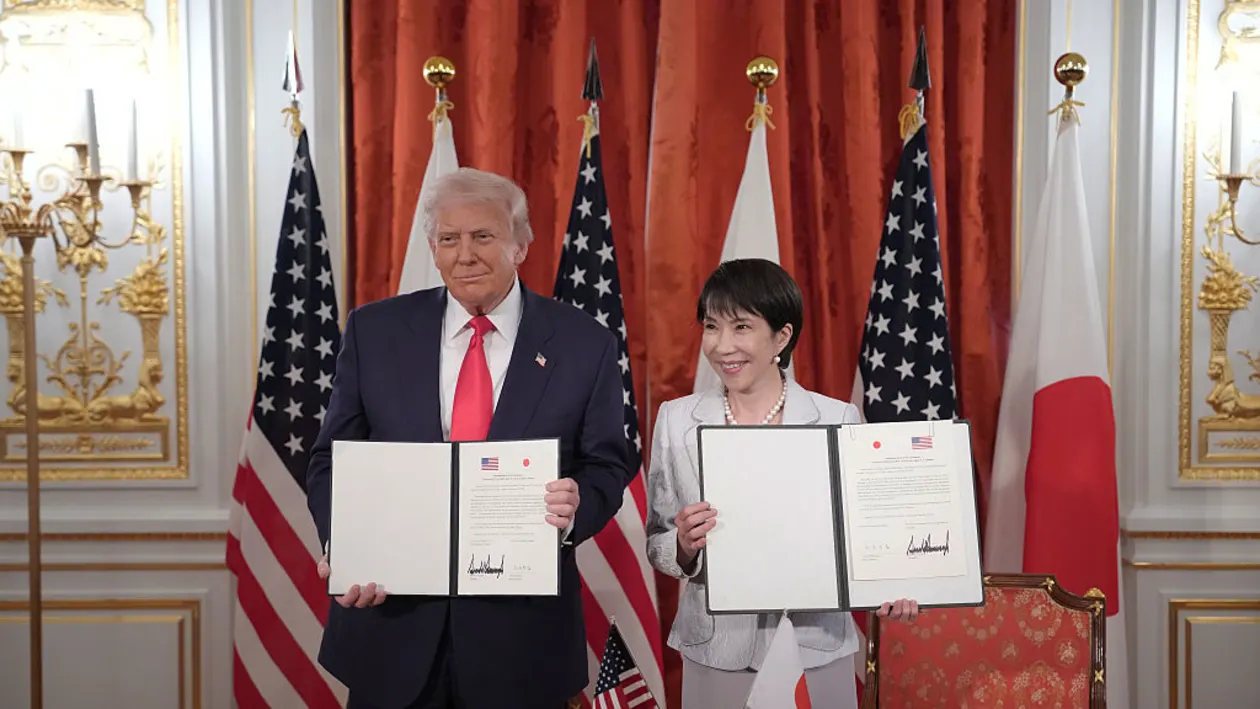
The Trump administration has revealed a trio of large-scale energy and industrial developments valued at approximately $36 billion, backed by Japanese investment as part of a broader U.S.-Japan trade arrangement. The projects, spanning Ohio, Texas, and Georgia, represent the first wave of capital deployment under Japan’s previously announced $550 billion investment commitment tied to tariff negotiations between the two countries.
According to the White House, the initiatives include a massive natural gas power plant in Ohio, a deepwater crude oil export terminal off the Texas coast, and a synthetic industrial diamond manufacturing facility in Georgia. The projects are designed to bolster U.S. energy capacity, strengthen strategic supply chains, and reduce reliance on foreign imports in key industrial sectors.
Energy Expansion in Ohio
The largest of the three undertakings is a natural gas-fired power generation facility in Portsmouth, Ohio. Valued at roughly $33 billion, the plant is projected to deliver 9.2 gigawatts of generating capacity, making it one of the largest natural gas power installations ever constructed.
The facility will be operated by SB Energy, a subsidiary of Japan-based SoftBank Group. Officials say the project aims to support growing electricity demand, particularly from expanding data center infrastructure that powers artificial intelligence applications and cloud computing services.
Commerce Secretary Howard Lutnick stated that the additional baseload generation would enhance grid reliability during a period of rapid digital infrastructure growth. The scale of the Ohio project underscores the increasing link between energy development and the expansion of AI-driven technologies.
Texas Gulf Coast Oil Export Facility
In Texas, Japanese financing will support the development of the Texas GulfLink deepwater crude oil export terminal. The offshore project, estimated at $2.1 billion, is being developed by Sentinel Midstream.
Officials indicated that the terminal could generate between $20 billion and $30 billion annually in U.S. crude exports once fully operational. The facility is expected to strengthen American export capacity and reinforce the country’s standing as a leading global energy supplier.
Although President Trump referenced a potential liquefied natural gas component in his remarks, official statements from the Commerce Department and the White House did not provide specific details about LNG infrastructure within the Texas initiative.
Texas GulfLink confirmed its participation and described the collaboration as a joint effort between U.S. and Japanese stakeholders to enhance strategic energy logistics.
Synthetic Diamond Production in Georgia
The third project focuses on advanced manufacturing in Georgia, where a synthetic industrial diamond facility will be constructed at an estimated cost of $600 million. The plant will be operated by Element Six, a subsidiary of De Beers Group.
Synthetic diamond grit is widely used in semiconductor fabrication, precision manufacturing, and other high-performance industrial applications. Currently, a significant portion of global supply originates from China.
Officials said the Georgia facility aims to meet the entirety of U.S. demand for synthetic diamond grit, reducing reliance on overseas suppliers and reinforcing domestic production capacity in critical materials.
Trade Framework and Tariff Negotiations
The projects are linked to a revised trade agreement that lowered U.S. tariffs on Japanese imports to 15 percent. President Trump emphasized that tariffs played a role in securing the investment commitments.
Under a prior agreement framework, profits from jointly financed projects would initially be shared equally between the United States and Japan until Japan recovers its initial investment. After that threshold, profit distribution would reportedly shift to a 90-10 split in favor of the United States.
Details regarding the precise funding structure of the current projects remain limited. Japan’s contribution is expected to involve a combination of equity participation, loans, and loan guarantees.
Japanese Government and Corporate Participation
Japan’s economic and trade minister Ryosei Akazawa confirmed that the three projects represent the first installment of a broader investment package pledged by Tokyo. He indicated that additional agreements may follow in the coming months.
Several Japanese corporations have expressed interest in participating in various aspects of the projects. Noritake is reportedly positioned as an off-taker in the diamond facility. Mitsui O.S.K. Lines and Nippon Steel have been mentioned in connection with the crude export initiative. Hitachi and Toshiba have been associated with the power generation project.
Japan’s state-backed financial institutions, including the Japan Bank for International Cooperation and Nippon Export and Investment Insurance, are expected to provide financing support through loans and guarantees.
Akazawa noted that the investment structure would not significantly impact foreign exchange markets, citing Japan’s substantial foreign currency reserves as a funding source.
Strategic Supply Chain Objectives
Officials in both countries framed the initiatives as part of a broader strategy to build resilient supply chains in strategically important sectors. Energy independence, advanced manufacturing inputs, and infrastructure capacity are central components of that strategy.
The Ohio and Texas projects are aimed at expanding U.S. energy production and export capability, while the Georgia diamond plant addresses vulnerabilities in critical materials supply.
The announcements followed recent discussions between U.S. Commerce Department officials and Japanese trade representatives to finalize outstanding elements of the investment package.
Additional projects are expected to be unveiled as part of the larger $550 billion commitment pledged by Japan before the end of the current U.S. presidential term.